How to Stop Masturbating: A Plan Built for Real Life
How to stop masturbating when willpower keeps failing: find your trigger moments, change your nights, handle the thoughts, and know what is normal on the way.
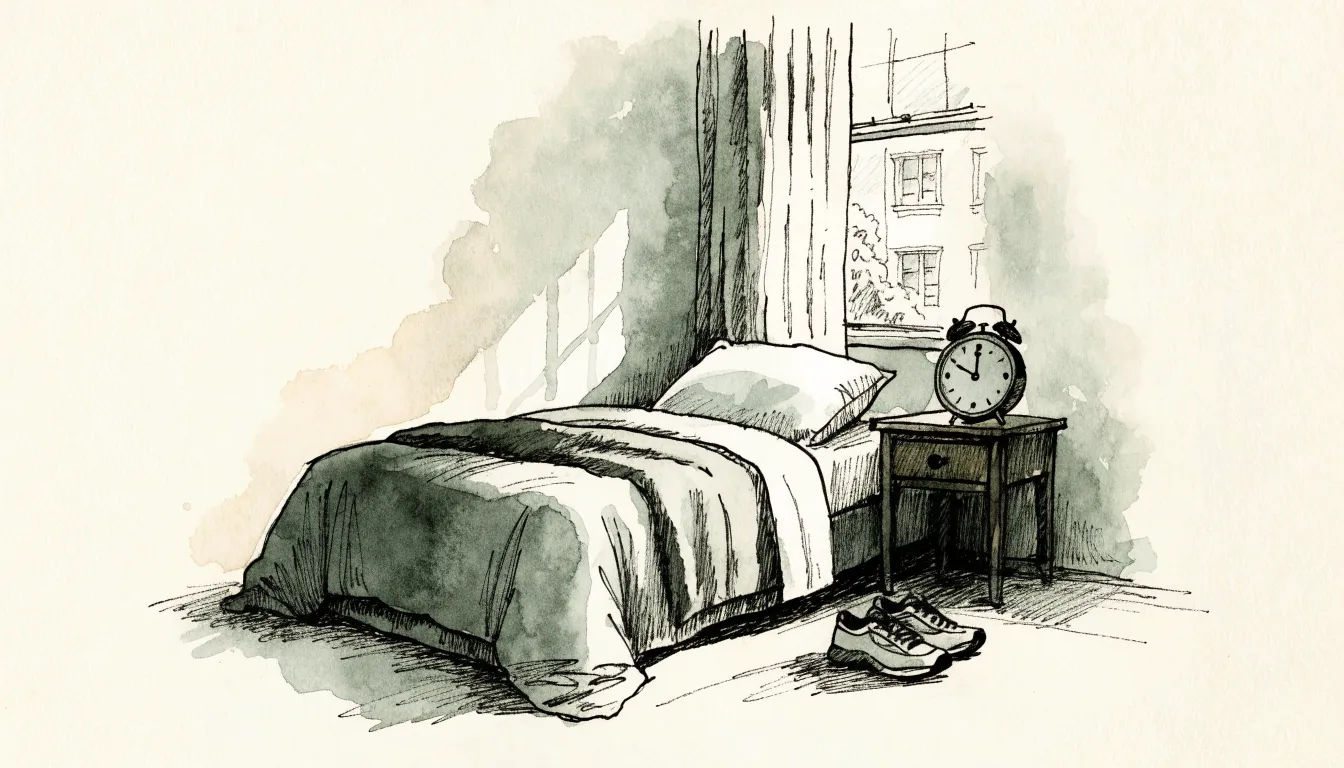
If you’ve tried to stop masturbating before, you probably made a firm decision, held out for a few days, and then found yourself back where you started, usually late at night or first thing in the morning. That isn’t a sign that you’re weak. It’s what happens when you try to beat a habit with a decision alone.
This guide on how to stop masturbating is built around the moments where the habit actually happens: your bed, your shower, the hour you can’t sleep, the afternoon you’re bored. It also covers the questions people worry about along the way, like whether stopping is unhealthy, what a wet dream means, and what to do after a slip.
Why is it so hard to stop masturbating?
Because it’s a habit, and habits don’t run on decisions. A habit is a behavior your brain has linked to a cue: a place, a time, a feeling. After enough repetitions, the cue starts the behavior before you’ve thought about it.1 That’s why you can be completely sure in the afternoon and find your resolve gone at 1 a.m.
Two things make this habit stickier than most:
- It needs nothing. No phone, no money, no other person. Most of the barriers that help with other habits don’t exist here.
- Its cues are part of daily life. Lying in bed, showering, being alone, feeling stressed or bored. You can’t avoid your own bed.
It’s also very common, which is worth saying because shame makes people feel alone. In a nationally representative US survey of adults aged 18 to 60, 61% of men and 38% of women reported masturbating in the previous year.2 Wanting to stop doesn’t make you strange, and neither does finding it hard.
First, decide what you’re aiming for
People want to stop for different reasons, and the reason shapes the plan.
- Faith or values. You believe it’s wrong and want your life to match what you believe. That’s a complete reason on its own. You don’t need a medical one.
- It feels out of control. You do it more than you want to, it eats time or sleep, or you use it to escape every bad feeling.
- It’s tied to porn. For many people the two come as a pair, and quitting one without the other rarely holds.
Some health sites will tell you masturbation is harmless and the only problem is guilt. On the physical side, they have a point: there’s no good evidence that it damages your body. But “it won’t hurt you” doesn’t answer “I don’t want to do it,” and this guide takes your goal as you state it. If your goal is to stop completely, the steps below are written for that. If it’s to cut back, they work the same way.
How to stop masturbating: 6 steps
1. Find your three moments
For two weeks, don’t try to change anything yet. Each time it happens, or nearly happens, write one line: the time, where you were, and how you felt just before. Use a note on your phone or a slip of paper.
Most people find that almost everything happens in two or three situations. Common ones:
- In bed, before falling asleep or after waking up
- In the shower
- Lying awake when you can’t sleep
- Home alone with nothing planned
- After a bad day, a fight, or a stressful deadline
Those moments are your real target. A general promise to “stop” spreads your effort across the whole day. A plan for three moments puts it where it counts.
2. Write an if-then plan for each moment
For each moment, decide in advance what you’ll do, and phrase it as “if this happens, then I’ll do that.” For example: “If I’m awake in bed for more than 15 minutes, then I’ll get up and read in the kitchen.” Or: “If I get home and the house is empty, then I’ll change and go for a walk before I sit down.”
This sounds too simple to matter, but it’s one of the best-studied tools in behavior change. A meta-analysis of 94 studies found that plans written in this if-then form clearly improved how often people followed through on their goals, compared with having the goal alone.3 The plan does the deciding ahead of time, so you don’t have to make a hard choice while tired or tempted.
3. Change your nights and mornings
For most people, the bed is the hardest place. A few changes help:
- Go to bed tired, not just late. Lying in bed scrolling until you feel sleepy is the setup for a lot of these nights.
- Phone out of the bedroom, or at least across the room. It’s both a trigger and a way to make the habit easier.
- Don’t lie awake. If you can’t sleep, get up for a while and come back when you’re drowsy. Lying in the dark with your mind wandering is exactly the situation to avoid.
- Get up when you wake up. Have one thing that gets you out of bed in the first minute: an alarm across the room, shoes by the bed, coffee set up the night before.
- Keep showers short and planned. Know what you’re going to do after the shower, so it doesn’t drift.
4. Cut the link with porn
If porn is part of the pattern, the two need to be tackled together. Porn adds a much stronger trigger than your own thoughts, and it’s often the first step of the evening. Our guide on how to stop watching porn walks through blocking it on your phone and other devices. Do that setup on a good day, not in the middle of a hard one.
5. Don’t fight the thoughts head-on
Many people say the hardest part isn’t images on a screen but memories and fantasies that come back on their own. The natural reaction is to push them away hard. That tends to backfire.
In a classic set of experiments, people told not to think about a white bear for five minutes kept thinking about it, and when they were later allowed to think about it, they thought about it more than people who had never tried to suppress it.4 Forcing a thought out keeps your mind checking for it.
What works better is to notice the thought, not argue with it, and turn your attention to something that needs it: get up, talk to someone, do something with your hands. If an urge comes with it, you can let it rise and fall instead of fighting it. This approach is called urge surfing. In a randomized study of 123 college smokers, those who learned it didn’t feel weaker urges, but they smoked fewer cigarettes over the following week.5 It’s a skill, so the first few times are the hardest. For a step-by-step version for the next few minutes, see what to do when the urge hits.
6. Tell one person
Secrecy makes this harder. You don’t need to announce it, but one person who knows (a friend, a spouse, a mentor, a priest, a counselor) changes the weight of the bad nights. Agree on something simple: you’ll text them when you’re struggling, or check in once a week. The point isn’t to be watched. It’s to stop carrying it alone.
Is it unhealthy to stop masturbating?
No. There’s no evidence that stopping harms you. You won’t build up anything dangerous, and your body has its own way of releasing tension during sleep (more on that below).
You’ll also run into the opposite claim online: that stopping gives you a big boost in testosterone, energy and confidence. That claim deserves some caution.
- The famous “day 7 testosterone peak” comes from a study that was retracted. A 2003 study of 28 men reported a testosterone spike on the seventh day without ejaculation. It was retracted by the journal in 2021, so it can’t be relied on.6
- The evidence that remains is small. A study of 10 men found somewhat higher testosterone after three weeks of abstinence.7 That’s a very small sample, and a modest change in a blood test isn’t the same as the life changes people describe online.
- One large study points the other way on one question. In a cohort of nearly 32,000 US men, those who reported ejaculating more often were somewhat less likely to be diagnosed with prostate cancer later, mainly low-risk cases.8 This was an association, not proof of cause, and it doesn’t mean stopping is dangerous. It’s one more reason not to trust anyone who says stopping will transform your body.
The honest version: stopping won’t hurt you, and it isn’t a health treatment either. The benefits people actually notice tend to be about having their time, their nights and their self-respect back. Those are good reasons on their own.
Wet dreams are not a relapse
When you stop, you may have a wet dream, an ejaculation during sleep. Many people who are trying hard to stop panic when this happens and count it as a failure. It isn’t.
Wet dreams are normal and healthy, and while they’re most common in the teen years, adults have them too. There’s nothing you can do to prevent them.9 They happen without your choice, which is exactly what makes them different from the habit you’re trying to change.
If you’re Catholic, the same logic applies. The Church teaches that serious sin requires full knowledge and “a consent sufficiently deliberate to be a personal choice.”10 Something that happens while you’re asleep has neither. Don’t reset your count, don’t confess it as a sin, and don’t let it start a spiral.
What to do after you slip
You will probably slip at least once. What you do in the next hour matters more than the slip itself.
The most common trap has a name: the abstinence violation effect. After breaking a firm rule, people tend to think “I’ve ruined it anyway,” and that thought turns one lapse into a lost week.11 A streak counter that drops to zero can make this worse, because it makes the slip feel like losing everything.
Instead:
- Don’t add a second one. The night of a slip is when the spiral starts. Get up, go somewhere else, sleep.
- Write one line in your log: what time it was, where you were, what happened before. Every slip shows you a moment your plan doesn’t cover yet.
- Fix the plan, not your character. If it was the shower again, the shower plan needs work. That’s a practical problem, not proof of who you are.
Progress here usually looks like slips getting further apart, not a perfect line. New routines take time to become automatic: in one well-known study of everyday habits, a median of about 66 days, with a wide range between people.1
When it’s more than a habit
For a smaller group of people, this is part of something bigger. The World Health Organization recognizes compulsive sexual behaviour disorder: a persistent pattern of failing to control intense, repetitive sexual urges, continuing despite repeated efforts to stop and despite harm to work, relationships or health, and causing significant distress.12 Distress that comes only from moral disapproval doesn’t count on its own for the diagnosis.13
Signs that it’s worth talking to a professional:
- You’ve tried for months and nothing changes
- It’s costing you sleep, work, school or relationships
- You use it to cope with almost every difficult feeling
- You feel hopeless, or it’s tied to depression or anxiety
Therapy for compulsive sexual behavior, mostly cognitive behavioral approaches, has been studied, though the research is still limited.14 Our guides to the symptoms of porn addiction and treatment for porn addiction cover how to tell the difference and how to find a therapist.
If you’re stopping for reasons of faith
For Catholics, the Church’s teaching is clear about the act itself: it calls masturbation “an intrinsically and gravely disordered action.” In the same paragraph, it says that judging a person’s responsibility must take into account “affective immaturity, force of acquired habit, conditions of anxiety, or other psychological or social factors that lessen or even extenuate moral culpability.”15 A long habit doesn’t make the act right, but it does matter to how God sees the person struggling with it.
The Catechism is also realistic about how long this takes. It calls self-mastery “a long and exacting work” that can never be considered “acquired once and for all,”16 and says chastity grows “through stages marked by imperfection and too often by sin.”17 Struggling for years isn’t a sign that you’re beyond help. It’s the normal shape of the effort the Church describes.
Saint Paul wrote a line many people hold on to:
No trial has come to you but what is human. God is faithful and will not let you be tried beyond your strength; but with the trial he will also provide a way out, so that you may be able to bear it.
1 Corinthians 10:13 (NABRE)
The “way out” is often very practical: getting out of bed, leaving the room, sending the text. Pair your plan with the sacraments. Regular confession, ideally with the same priest, gives you a place to bring each fall without hiding it. If you haven’t been in a while, our free examination of conscience can help you prepare, and nothing you mark is saved. A priest or spiritual director can help you with the parts no article can. If the harder fight is with thoughts and looking rather than the act itself, see our guide on how to overcome lust.
Frequently asked questions
How long does it take to stop masturbating?
There’s no fixed timeline, and claims of a set number of days aren’t backed by research. Habit studies suggest new routines take about two months on average to feel automatic, with a wide range between people. Most people see the urges get weaker and the slips get further apart over the first few months.
What happens if you stop masturbating?
Physically, not much: there’s no evidence that stopping harms you, and wet dreams may happen, which is normal. The early weeks often bring stronger urges, especially at night. What people tend to notice over time is more control over their evenings and less of the cycle of giving in and feeling bad.
Does not masturbating increase testosterone?
The popular claim of a testosterone peak on day 7 comes from a 2003 study that was later retracted. A separate study of 10 men found somewhat higher testosterone after three weeks of abstinence, but that’s too small to support the big claims made online. Stopping isn’t a reliable way to raise testosterone.
Is it unhealthy to masturbate every day?
There’s no evidence that frequency alone causes physical harm. The questions that matter are whether you can stop when you want to, and whether it’s costing you sleep, work, relationships or peace of mind. The WHO defines the disorder by loss of control and its consequences, not by a number.
Can God forgive masturbation?
Yes. The Catechism says there is no offense, however serious, that the Church cannot forgive when repentance is honest, and the sacrament of confession exists for exactly this.18 The Catechism also says that habit, anxiety and immaturity can lessen a person’s responsibility. Going back to confession after a fall is part of the effort, not a failure of it.
Sources
-
Lally, P., van Jaarsveld, C. H. M., Potts, H. W. W., & Wardle, J. (2010). How are habits formed: modelling habit formation in the real world. European Journal of Social Psychology, 40(6), 998–1009. ↩ ↩2
-
Das, A. (2007). Masturbation in the United States. Journal of Sex & Marital Therapy, 33(4), 301–317. ↩
-
Gollwitzer, P. M., & Sheeran, P. (2006). Implementation intentions and goal achievement: a meta-analysis of effects and processes. Advances in Experimental Social Psychology, 38, 69–119. ↩
-
Wegner, D. M., Schneider, D. J., Carter, S. R., & White, T. L. (1987). Paradoxical effects of thought suppression. Journal of Personality and Social Psychology, 53(1), 5–13. ↩
-
Bowen, S., & Marlatt, G. A. (2009). Surfing the urge: brief mindfulness-based intervention for college student smokers. Psychology of Addictive Behaviors, 23(4), 666–671. ↩
-
Jiang, M., Xin, J., Zou, Q., & Shen, J. W. (2003). A research on the relationship between ejaculation and serum testosterone level in men. Journal of Zhejiang University Science, 4(2), 236–240. Retracted in 2021 (retraction notice). ↩
-
Exton, M. S., Krüger, T. H., Bursch, N., et al. (2001). Endocrine response to masturbation-induced orgasm in healthy men following a 3-week sexual abstinence. World Journal of Urology, 19(5), 377–382. ↩
-
Rider, J. R., Wilson, K. M., Sinnott, J. A., Kelly, R. S., Mucci, L. A., & Giovannucci, E. L. (2016). Ejaculation frequency and risk of prostate cancer: updated results with an additional decade of follow-up. European Urology, 70(6), 974–982. ↩
-
Cleveland Clinic. (2026). Are “wet dreams” normal and healthy? Interview with Veronica Issac, MD. ↩
-
Marlatt, G. A., & Gordon, J. R. (Eds.). (1985). Relapse Prevention: Maintenance Strategies in the Treatment of Addictive Behaviors. Guilford Press. ↩
-
World Health Organization. ICD-11 for Mortality and Morbidity Statistics, 6C72 Compulsive sexual behaviour disorder. ↩
-
Kraus, S. W., Krueger, R. B., Briken, P., et al. (2018). Compulsive sexual behaviour disorder in the ICD-11. World Psychiatry, 17(1), 109–110. ↩
-
Antons, S., Engel, J., Briken, P., Krüger, T. H. C., Brand, M., & Stark, R. (2022). Treatments and interventions for compulsive sexual behavior disorder with a focus on problematic pornography use: a preregistered systematic review. Journal of Behavioral Addictions, 11(3), 643–666. ↩
If you are having thoughts of harming yourself, call or text 988 (US) or reach your local emergency number. You deserve help from a real person today.