Examination of Conscience: Catholic Guide for Confession
A Catholic examination of conscience for adults, drawn from the Ten Commandments and the Catechism. Check what applies and review your list. Nothing is saved.
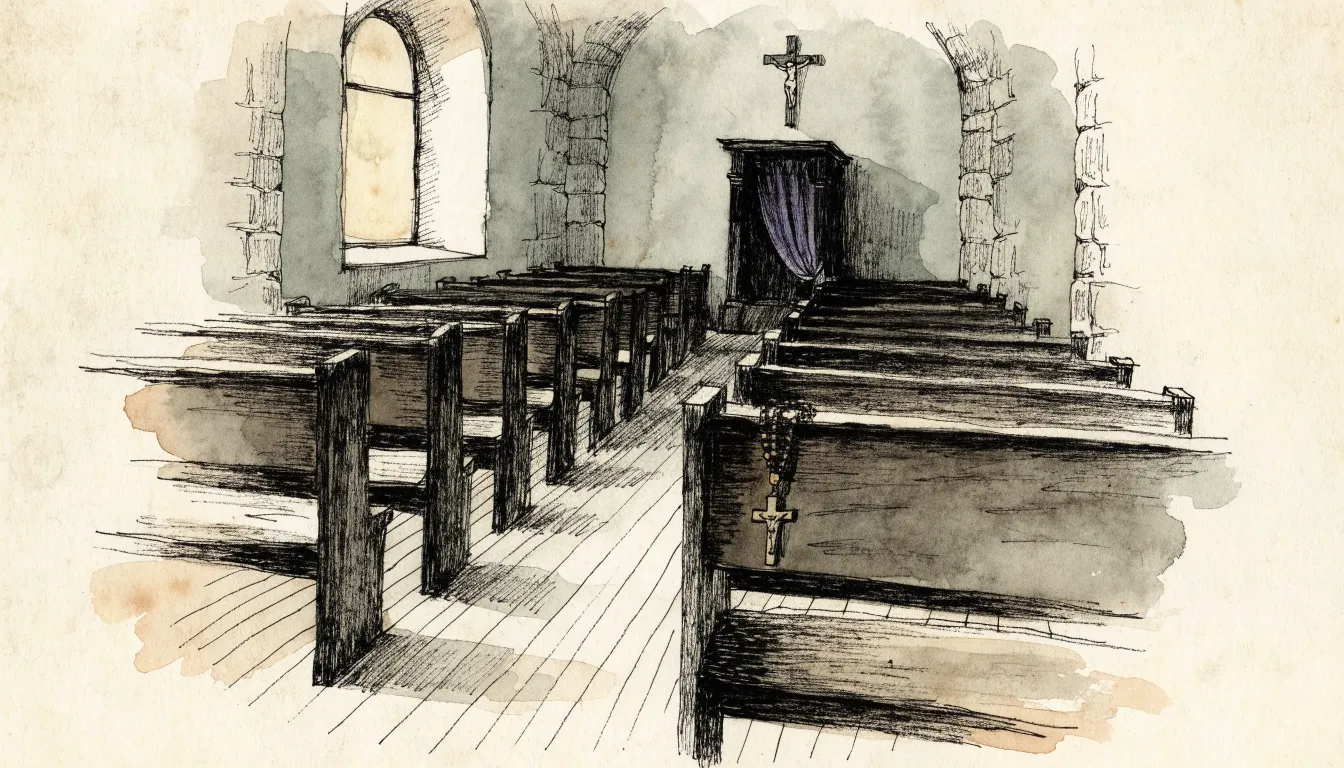
The hardest part of going to confession is often the few minutes before it: trying to remember what to say, with a vague sense that you’re forgetting something. An examination of conscience is the Church’s answer to that moment. The Catechism says the sacrament “ought to be prepared for by an examination of conscience made in the light of the Word of God” (CCC 1454).
This one walks through the Ten Commandments and the precepts of the Church, with plain questions drawn from the Catechism. Check anything you want to bring to confession, then tap Review my list to see only what you checked, in larger type, ready to read before you go in.
It’s private by design. Nothing you check is saved on your phone or sent anywhere, and it all disappears when you close the page. If you’d rather use paper, print a blank copy.
Before you begin, take a moment of quiet and ask for help. A simple prayer is enough: Come, Holy Spirit. Help me to see my sins honestly, to be truly sorry for them, and to trust in your mercy.
Examine your conscience
Check anything you want to bring to confession. Nothing is saved or sent anywhere: your checks disappear when you close or reload this page.
These are the questions you checked. Read them over, add how many times if you can, and bring them to confession.
charbelia.com/recovery/examination-of-conscience
You haven't checked anything yet. Go back to the questions and check what applies, or simply bring what comes to mind.
The First Commandment
I am the Lord your God: you shall not have strange gods before me
Putting God first: faith, hope, love of God, and worship given to him alone. CCC 2084–2132
The Second Commandment
You shall not take the name of the Lord your God in vain
Respect for the name of God, of Jesus, of Mary and the saints, and for promises made before God. CCC 2142–2159
The Third Commandment
Remember to keep holy the Lord's Day
Sunday and holy days: Mass, rest, and time for God, family and the works of mercy. CCC 2168–2195
The Fourth Commandment
Honor your father and your mother
Family and authority: parents and children, spouses, and our duties as citizens. CCC 2197–2257
The Fifth Commandment
You shall not kill
Respect for human life and health: our own and others', in body and in soul. CCC 2258–2330
The Sixth Commandment
You shall not commit adultery
Chastity in actions, according to one's state of life, single or married. CCC 2331–2400
The Seventh Commandment
You shall not steal
Justice with what belongs to others: property, work, fair dealing and care for the poor. CCC 2401–2463
The Eighth Commandment
You shall not bear false witness against your neighbor
Truthfulness, and respect for other people's reputation and secrets. CCC 2464–2513
The Ninth Commandment
You shall not covet your neighbor's wife
Purity of heart: thoughts, desires, the eyes, and modesty. CCC 2514–2533
The Tenth Commandment
You shall not covet your neighbor's goods
Freedom from greed and envy: being content and generous. CCC 2534–2557
Also examine
The precepts of the Church
The minimum the Church asks of every Catholic, so that prayer and the sacraments stay part of life. CCC 2041–2043
What is an examination of conscience?
It’s an honest, prayerful look back at your life since your last confession, measured against God’s law: what you’ve done and failed to do, in thought, word and action. It isn’t meant to make you feel crushed. It’s meant to help you see clearly, so you can bring your sins to God and receive his forgiveness.
The Ten Commandments are the most common guide, because the Catechism teaches that they specify what counts as grave matter.1 Many Catholics also use the Beatitudes, the seven capital sins or the two great commandments of love. Any of them works, as long as you use it honestly.
How to make a good examination of conscience
- Find a few quiet minutes. Ten or fifteen is usually enough. Put your phone on silent, or use this page and nothing else.
- Ask the Holy Spirit for light. You’re not trying to remember everything by willpower. You’re asking God to show you what he wants you to see.
- Go through the questions slowly. Check what applies. Don’t rush past the uncomfortable ones, and don’t agonize over the ones that clearly don’t fit your life.
- Be specific. For serious sins, the Church asks you to confess the kind of sin and, as far as you can, how many times.2 “I lied to my wife about money, three times” is more honest than “I wasn’t always truthful.”
- Be sorry, and decide to change. Contrition is “sorrow of the soul and detestation for the sin committed, together with the resolution not to sin again.”3 Think of one concrete step you’ll take, especially for the sin you struggle with most.
Mortal and venial sin: what you must confess
Not every sin is the same. The Catechism teaches that for a sin to be mortal, three conditions must all be met: “Mortal sin is sin whose object is grave matter and which is also committed with full knowledge and deliberate consent.”4
- Grave matter: something seriously wrong, as specified by the Ten Commandments.1
- Full knowledge: you knew it was seriously wrong.
- Deliberate consent: you chose it freely, as a personal decision.5
Ignorance you couldn’t help, strong passions, fear, and habit can reduce how responsible you are.6 That’s why the same act can be a mortal sin for one person and less serious for another, and why it’s wise to tell the priest about circumstances you’re unsure of.
All mortal sins you’re aware of after a careful examination must be confessed, even the most private ones.7 Confessing venial sins isn’t strictly required, but the Church strongly recommends it, because it helps form your conscience and fight bad habits.8 If you’re not sure whether something was serious, mention it and ask.
How to go to confession, step by step
Customs vary a little from parish to parish, and you can usually choose to confess face to face or behind a screen. A simple pattern that works almost everywhere:9
- Begin. Make the Sign of the Cross. Say: “Bless me, Father, for I have sinned. It has been [how long] since my last confession.”
- Confess your sins. Read from your list if it helps. If you don’t know how to say something, it’s fine to say, “Father, I’m not sure how to say this.”
- Finish. Say something like, “For these and all my sins, I am sorry,” or simply, “That’s all, Father.”
- Listen. The priest may offer advice and will give you a penance, often prayers or an action.
- Pray an Act of Contrition. You can say it in your own words or use a traditional prayer like the one below.
- Receive absolution. The priest prays the words of absolution. Make the Sign of the Cross.
- Do your penance as soon as you reasonably can.
If you’ve been away for years, say so at the start. Priests are used to hearing it, and they can help you through the rest.
An Act of Contrition
This traditional version comes from the Baltimore Catechism, used in American parishes for generations:9
O my God, I am heartily sorry for having offended Thee, and I detest all my sins, because I dread the loss of heaven and the pains of hell, but most of all because they offend Thee, my God, who art all-good and deserving of all my love. I firmly resolve, with the help of Thy grace, to confess my sins, to do penance, and to amend my life. Amen.
Your parish may use a slightly different wording. Any sincere act of contrition is fine.
If you struggle with the same sin again and again
Confessing the same sin over and over can feel like failure. It isn’t. Coming back is what confession is for. The Church teaches that the sacrament restores “God’s grace” and “intimate friendship” with him, and that it is often followed by “peace and serenity of conscience.”10
When the sin is tied to a habit, like pornography, the Church also recognizes that “force of acquired habit, conditions of anxiety, or other psychological or social factors” can lessen moral culpability.11 That isn’t permission to stop fighting. It’s a reason not to despair, and a reason to get practical help alongside the sacraments. Our guides on how to stop watching porn and how to recover from porn addiction cover what to do between confessions.
If examining your conscience fills you with anxiety
Some people find that examining their conscience never feels finished: they replay the same doubts, confess things repeatedly, and still don’t feel forgiven. That pattern has a name, scrupulosity, which clinicians describe as pathological guilt about religion and morality, or “fearing sin where there is none.” Up to a third of people with obsessive-compulsive disorder have scrupulosity symptoms.12
If that sounds familiar, two things help. Choose one regular confessor and follow his guidance about what to confess, rather than re-examining on your own. And consider talking to a mental health professional who treats OCD, because evidence-based treatments for scrupulosity exist.12
Frequently asked questions
How often should Catholics go to confession?
The Church requires Catholics to confess serious sins at least once a year. Many go more often, monthly or every few weeks, because regular confession of everyday faults helps form the conscience and grow in the spiritual life. Anyone aware of a mortal sin should go to confession before receiving Communion.
What are the three conditions for a mortal sin?
The sin must involve grave matter, be committed with full knowledge that it is seriously wrong, and be chosen with deliberate consent. All three must be present. If any is missing, the sin is not mortal, though it may still be a venial sin worth confessing.
Do I have to confess venial sins?
No, confessing venial sins isn’t strictly required. But the Church strongly recommends it, because regular confession of everyday faults helps you form your conscience, fight bad habits and grow closer to God.
Can I bring a list into confession?
Yes. Many people bring a written list or read from their phone, and priests are used to it. This page’s review mode shows only what you checked, in larger type, so you can read it easily. Just remember that nothing here is saved, so keep the page open until you’re done.
Is this examination of conscience private?
Yes. Nothing you check is stored on your device or sent anywhere. Your checks exist only while the page is open and disappear when you close or reload it. If you print, you get a blank copy without your checks.
What should I do if I forget a sin during confession?
Don’t panic. The Church asks for a careful examination, not a perfect memory. A serious sin you forgot is still one you haven’t confessed, so mention it at your next confession. Venial sins you forget don’t need to be brought back at all.
Sources
-
A Catechism of Christian Doctrine, No. 1 (Baltimore Catechism), including “The right manner of confessing,” Project Gutenberg edition. ↩ ↩2
-
Mathews, R. E., & Sarawgi, S. (2025). From doubt to direction: untangling pediatric scrupulosity. Children, 12(4), 528. ↩ ↩2
If you are having thoughts of harming yourself, call or text 988 (US) or reach your local emergency number. You deserve help from a real person today.